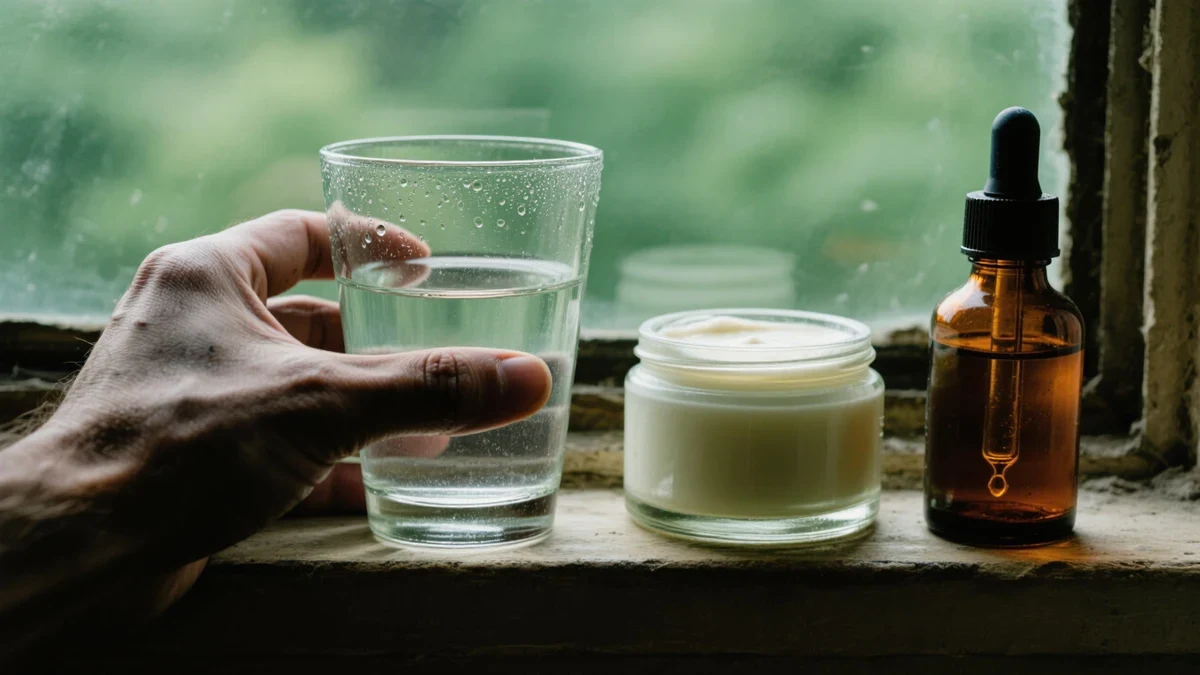
Drinking extra water has at best a modest, conditional effect on skin hydration: in a trial published in Annals of Dermatology in 2024, additional moisturizer had a more favorable impact on skin hydration than additional water intake. A Clinics in Dermatology review found no scientific proof behind the eight-glasses rule at all.
Where did the eight-glasses claim come from?
Not from controlled research, per a review published in Clinics in Dermatology. Its authors wrote that how-to books, beauty journals, the internet and the media usually recommend drinking six to eight glasses of water daily for hydrated, healthier, wrinkle-prone-resistant skin, and that they found no scientific proof for this recommendation; nor is there proof, they noted, that drinking less water does no harm. The review's conclusion is often summarized as: at the end of the day, scientific evidence to validate the instinct remains missing, and the belief is a myth.
That is an absence-of-evidence finding rather than evidence of no effect, a distinction the authors themselves draw. But fifteen years later the higher-quality trial evidence that has arrived does not rescue the rule, and in direct comparison the topical route wins decisively.
What did the 2024 trial measure?
Skin barrier numbers. The Annals of Dermatology study, published in June 2024, classified 43 healthy female participants by baseline daily water intake, above or below one liter per day, then sub-divided them into groups receiving additional water, moisturizer, both, or neither. Transepidermal water loss and stratum corneum hydration were measured at baseline, week 2 and week 4.
At baseline there was no significant difference in hydration or water loss between high and low intake groups. Stratum corneum hydration did rise significantly by week 4 in the moisturizer groups, at the forearm, hand dorsum and shin. The authors' conclusion is the line that matters for anyone allocating shelf budget: the degree of water intake may be related to improved skin barrier function, but application of additional moisturizers had a more favorable impact on skin hydration than additional water intake.
Who might benefit from drinking more?
People starting from low intake, possibly. A review in Children, published in 2023, examining water intake and atopic dermatitis, stated that normal skin hydration increases with dietary water intake, particularly in those with prior lower water consumption, while also reporting that the effectiveness of adequate water intake as a measure to treat dry skin is still under debate. Its framing on treatment is unambiguous: among the methods used to treat dry skin, topical leave-on products are the first-line treatment.
That leaves hydration claims in a recognizable evidence shape: plausible mechanism, small conditional effect at the low-intake margin, and a topical alternative with far stronger support. None of this touches plain health reasons to drink adequately; it is specific to the beauty claim that extra glasses convert to visibly hydrated skin.
| Claim | What the evidence shows | Source |
|---|---|---|
| Six to eight glasses hydrates skin | No scientific proof found for the recommendation | Clinics in Dermology review, 2010 |
| Extra water vs moisturizer | Moisturizer had the more favorable impact on skin hydration at 4 weeks | Annals of Dermatology trial, 2024 |
| Baseline water intake groups | No baseline hydration difference between high and low intake groups | Annals of Dermatology trial, 2024 |
| Water intake in dry-skin conditions | Effect still under debate; leave-on topicals are first-line | Children review, 2023 |
What actually hydrates skin, then?
The boring, evidenced stack, in order:
- Apply a leave-on moisturizer daily; it beat extra water in direct comparison in the 2024 trial.
- Drink to normal thirst and health guidance rather than above it for skin's sake; the baseline comparison found no hydration advantage in high-intake groups.
- Use occlusive or humectant formulas on dry-prone areas; the trial's moisturizer gains showed at forearm, hand and shin.
- See a dermatologist for persistent dryness, itching or flaking, which can signal treatable skin conditions rather than a hydration shortfall.
A note on where hydration marketing and dermatology part ways. Facial mist and internal-hydration product stories frequently lean on the plausible end of the water research, the small conditional effect at low baseline intake, without the trial's comparison arm. The 2024 study's design answers the question a shelf actually poses: given the same four weeks, the group holding a moisturizer gained more stratum corneum hydration than the group holding an extra liter per day. That comparison, not the mechanism alone, is what should inform budget allocation.
What the evidence does not show is any study in which drinking water above adequate intake outperformed, or even matched, a basic moisturizer for skin hydration. Until one exists, the eight-glasses-for-glowing-skin claim stays where the Clinics in Dermatology reviewers left it: a widely repeated idea awaiting its evidence.
This article is for informational purposes only and is not medical advice. For persistent dry skin or any skin concern, consult a dermatologist or qualified healthcare professional.