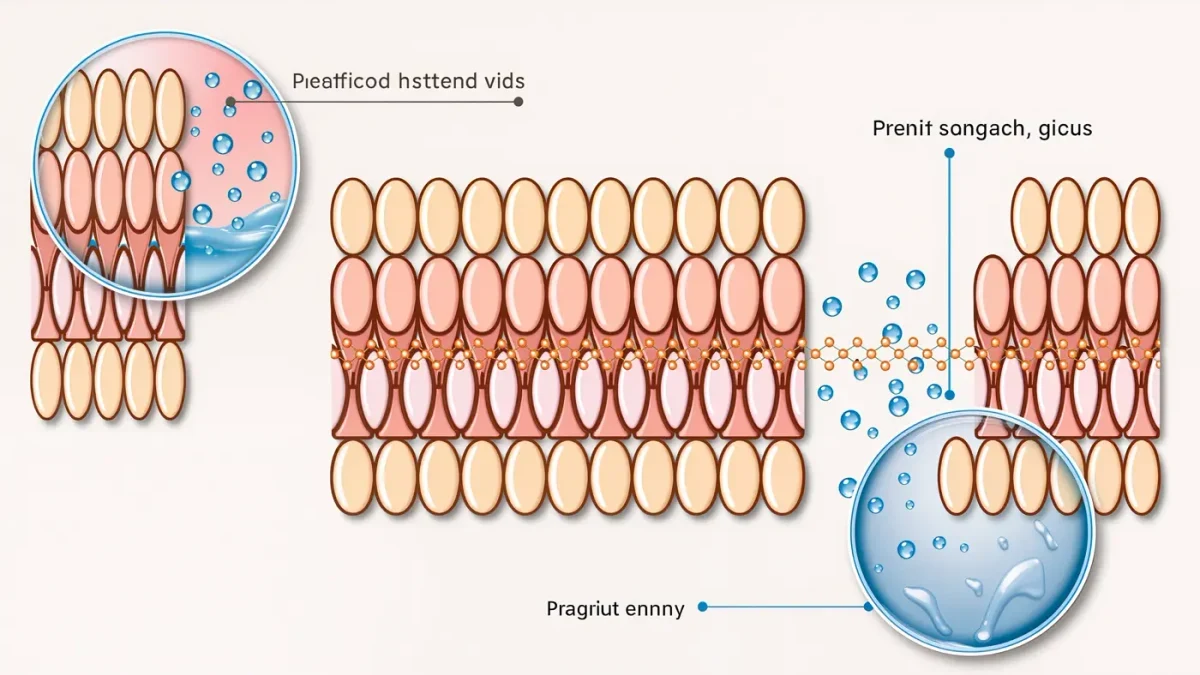
The skin barrier is the stratum corneum, a brick-and-mortar structure in which corneocyte cells sit in a lipid matrix rich in ceramides, cholesterol, and fatty acids. A Journal of Clinical Medicine review by pharmacist Yoshinori Takagi of Josai University notes that ceramide levels decrease in the stratum corneum of people with atopic dermatitis, weakening barrier function and water retention.
What is the barrier actually made of?
Three lipid families in a roughly balanced matrix, with ceramides the largest share. Ceramides are lipid molecules with a sphingoid base and a fatty acid chain, and the skin synthesizes them in the epidermis as corneocytes mature. Takagi's review, summarizing work on a synthetic pseudo-ceramide called cetyl PG hydroxyethyl palmitamide, or SLE66, explains that this molecule and a eucalyptus leaf extract "enhance ceramide synthesis in the epidermis," and that a moisturizer containing both "improves the barrier functions and water holding capacity of AD skin," per the review in the Journal of Clinical Medicine. The framing matters: moisturizers support the barrier the skin builds, and ingredients that nudge the skin's own lipid production are the mechanism, not a sealed coating. The review's account of atopic skin explains why barrier talk dominates eczema care: when ceramide levels fall, the mortar between cells develops gaps, water escapes faster than it is replaced, and irritants that a healthy barrier would deflect reach living tissue. Roughness, tightness, and reactivity are the felt consequences of that physics, which is also why a moisturizer's effect shows up as measured changes in water loss and holding capacity in the studies Takagi summarizes, not as an overnight visual transformation.
What do ceramide creams do for compromised skin?
The strongest evidence sits in eczema and atopic-prone skin. A systematic literature review and consensus in the Journal of Drugs in Dermatology, authored by a panel including Lawrence Schachner and Peter Lio, concluded that "daily use of moisturizers that contain lipids, such as ceramides, reduces the rate of AD flares and the need for topical steroid treatment," while cautioning that moisturizer use in early infancy "may delay rather than prevent AD," per the consensus paper. The panel also observed that the protective effect "has been observed in studies where its daily use is ongoing" and that benefits "may be lost in less than 1 year after cessation," which explains why consistency, not product switching, is the variable that moves outcomes. The panel's counseling position also leans on routine structure: gentle cleansers plus moisturizers containing barrier lipids, used from birth onward in atopic-prone infants, may delay onset and mitigate severity, and the same logic extends to adults managing a compromised barrier, where the moisturizer is maintenance therapy in everything but name.
How much ceramide is in products, and is it safe?
Typical use levels run well under one percent to a few percent, and the published safety math is generous. A risk assessment in Food and Chemical Toxicology by Soo Choi and Byung-Mu Lee of Sungkyunkwan University assumed ceramide 3 concentrations of 0.5 to 10% across product types and calculated margins of safety for each, finding "no safety concerns for cosmetic products containing less than 1% ceramide 3," per the assessment. A margin of safety compares estimated exposure to the dose at which no adverse effect is observed, so values in the hundreds to thousands indicate wide buffers at the concentrations cosmetics actually use. Choi and Lee's paper is also a reminder that ceramide content is a formulation fact brands control and rarely print, so a shopper cannot verify a percentage from the shelf, only the ingredient's presence.
| Product type (assumed ceramide 3 level) | Margin of safety | Assessment |
|---|---|---|
| Lipstick (up to 10%) | 4111 | Considered safe |
| Shampoo (0.5%) | 148 | Known to be safe |
| Body lotion, hands (1%) | 103 | Safe |
| Body lotion, back (5%) | 168 | Safe |
| Face cream (up to 3%) | 149 | Anticipated safe |
How do you support a barrier that is struggling?
The dermatology consensus points to boring consistency over product churn. A basic routine, assembled from the counseling recommendations in the Journal of Drugs in Dermatology consensus, looks like this:
- Cleanse once daily with a gentle, non-stripping cleanser in lukewarm water.
- Apply a ceramide-containing moisturizer every day, not only during flares, since the documented benefit depends on ongoing use.
- Apply to damp skin within minutes of bathing to support water retention.
- Keep the routine stable for weeks before judging it, because barrier repair studies measure outcomes over months, not days.
What the evidence does not show: no moisturizer prevents atopic dermatitis outright, and ceramide labeling on a front of a bottle confirms an ingredient, not a clinical outcome. Higher price does not track with higher ceramide content, since concentrations are rarely printed.
This article is for informational purposes only and does not constitute medical advice. Cosmetics are not treatments for medical conditions. For persistent skin, hair, or scalp concerns, consult a dermatologist or qualified healthcare professional.