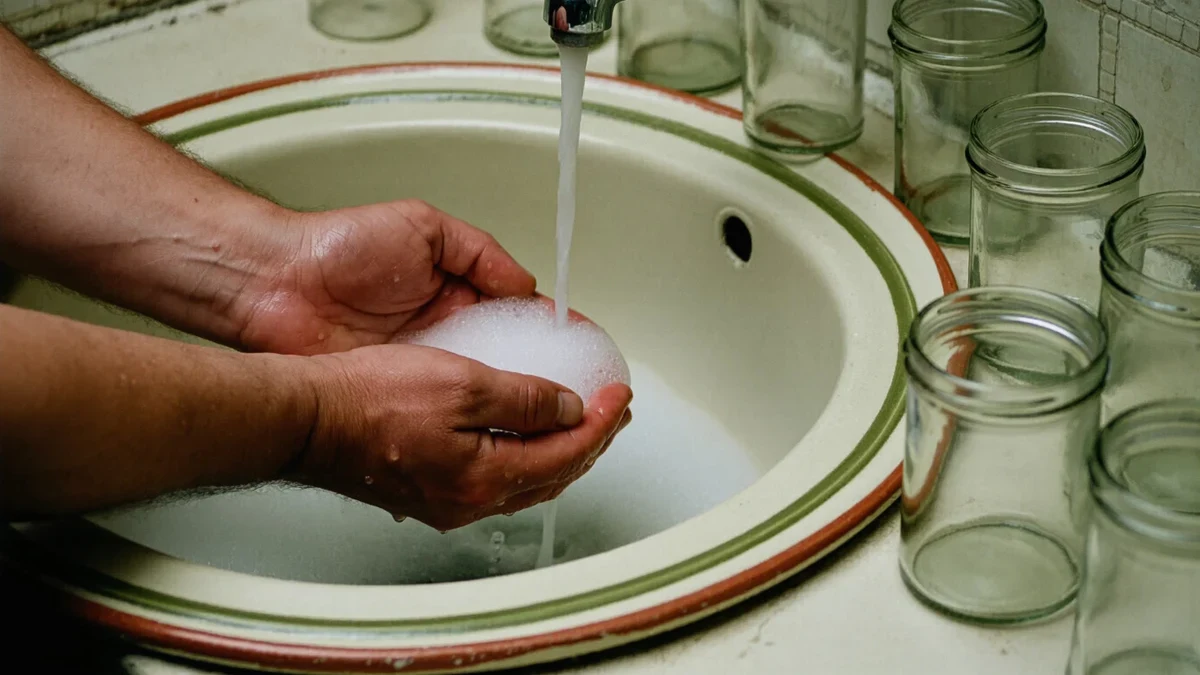
A cleanser is a surfactant-based formula that lifts oil, sweat and debris off the skin so they rinse away with water. In a review in the Journal of Cosmetic Dermatology, dermatologist Zoe Draelos explains that cleansers are composed of alkaline soaps or the less barrier-damaging synthetic detergents known as syndets — and the surfactant determines the cost to the barrier.
What is the difference between soap and syndet?
Traditional soap is made by reacting fats with an alkali, and the result is alkaline — far above skin's naturally acidic surface pH. Syndets, short for synthetic detergents, are surfactants synthesized to clean at a pH closer to skin's own. The difference is chemistry first and packaging second.
The difference is not cosmetic. According to Draelos's review in the Journal of Cosmetic Dermatology, the lower skin irritation and dryness found with syndets are related to their reduced tendency to cause protein denaturation in the stratum corneum, driven by the charge density of protein-bound micelle-like surfactant aggregates. In plain terms, soap's chemistry is more likely to unravel the skin's own structural proteins, while syndet surfactants bind more loosely and cause measurably less damage.
For label readers, the practical translation is simple: "soap-free" on a cleanser usually signals a syndet base, and that claim has a mechanistic basis in the published literature rather than being pure marketing.
Why does cleansing matter so much for sensitive skin?
Sensitive skin is not a niche concern. A review in the American Journal of Clinical Dermatology by Dr. Wong Keang Cheong reports that sensitive skin is reported by 40 to 50% of women and 30% of men in the US, Europe and Japan. The same review lists effective cleansers that do not compromise skin barrier integrity as a basic requirement in managing eczema-prone and sensitive skin.
The mechanism connects back to barrier structure. Inflammation and dryness disrupt the stratum corneum barrier, which predisposes skin to further dryness and increases susceptibility to irritants — a cycle a harsh cleanser can restart every morning and night.
Studies cited in the American Journal of Clinical Dermatology review reported clinical improvement when soap-free cleansers were used in combination with topical treatments. The cleanser, in other words, is not a neutral bystander in a routine; it is the step that either protects or erodes everything applied afterwards.
How do you match a cleanser to your skin type?
Dermatological guidance frames cleansing as need-based, not product-based. Oily and acne-prone skin often tolerates — and may benefit from — stronger degreasing surfactants or active washes, while dry, rosacea-prone or eczema-prone skin needs the mildest syndet that still removes sunscreen and makeup.
Body skin is denser in sebaceous glands in some areas and drier in others, so a single wash for face and body is rarely optimal for barrier-conscious readers. Cleansing formulations, as Draelos notes, are available to meet hygiene needs varying by age, environment, personal preference and the presence or absence of skin disease.
Mature skin deserves a specific word: sebum output declines with age, so a wash that felt balanced at twenty can feel stripping at sixty. The review literature's barrier logic suggests moving earlier rather than later toward milder surfactants as skin changes. Climate plays the same role: a syndet that feels perfect in humid summers may need a creamier follow-up in dry winter air.
| Cleanser type | Chemistry | Documented effect on barrier |
|---|---|---|
| True soap (bar or liquid) | Alkaline saponified fats | Higher protein denaturation; more irritation and dryness (per Journal of Cosmetic Dermatology review) |
| Syndet ("soap-free") | Synthetic detergent surfactants, pH closer to skin | Lower irritation and dryness; reduced protein damage |
| Soap-free plus moisturizer | Syndet base with emollients/humectants | Clinical improvement when paired with topical treatment (per American Journal of Clinical Dermatology review) |
What about double cleansing and cleansing tools?
The oil-cleanser-first, water-based-cleanser-second sequence is a technique, not a tested clinical intervention; the reviewed literature addresses surfactant chemistry rather than cleansing choreography. Its logic is compatible with the science — an oil phase dissolves sunscreen and long-wear pigments so the syndet phase works less hard — but no study in these reviews demonstrates superior outcomes from two steps over one.
Tools deserve more caution than technique. Washcloths and brushes add mechanical exfoliation on top of chemical cleansing, and the barrier reviews' caution about cumulative irritation applies: anything that leaves skin tight, red or stinging has exceeded what the stratum corneum can absorb that day. Fingertips remain the reference applicator in the reviewed guidance for sensitive skin.
Water temperature deserves the same skepticism as tooling. The barrier's lipids are temperature-sensitive, and extended hot exposure works alongside surfactants to strip them — which is why lukewarm water, unglamorous as it sounds, is part of the barrier-preserving sequence rather than spa folklore.
What does a barrier-friendly washing routine look like?
The published guidance supports a short, repeatable process rather than elaborate rituals. Based on the requirements set out in the American Journal of Clinical Dermatology review — cleanse without compromising barrier integrity, alleviate dryness, then restore the barrier — a routine reads as follows.
- Wash twice daily with a soap-free syndet cleanser chosen for your skin's oiliness.
- Use lukewarm water and fingertips rather than abrasive tools; extended hot water soaking strips lipids.
- Pat — do not rub — until just dry, leaving slight residual moisture.
- Apply moisturizer within minutes to seal that water and support the barrier.
- Scale frequency, not surfactant strength: after heavy sweat or sunscreen, re-cleanse gently rather than switching to a harsher wash.
What the evidence does not show
No study demonstrates benefit from cleansing more than twice daily in normal skin, and no surfactant has been shown to draw impurities out from beneath the skin's surface — that concept simply does not appear in this literature. Equally, syndet does not mean zero effect: all surfactants remove some barrier lipids, which is why the moisturizing step is part of the evidence-based routine rather than an optional extra.
The payoff for getting cleansing right compounds across a routine. Cheong's review notes that therapeutic moisturizers improve hydration, reduce irritation susceptibility and restore stratum corneum integrity — but all of that work begins on skin that has just been washed. A stripping cleanser makes the next three products compensate; a syndet lets them build. That sequencing logic, not any single hero product, is the dermatological takeaway.
Price, for the record, is not the variable any of this research measures. Barrier outcomes tracked surfactant chemistry and habit, not brand tier — a fact budget-conscious readers can bank.
This article is for informational purposes only and does not constitute medical advice. For persistent dryness, irritation or eczema, consult a dermatologist or qualified healthcare professional.