Setting sprays hold makeup in place with film-forming polymers that dry into an invisible layer over pigment, and the newest launches are leaning on plant-derived versions of those polymers. Saie's CitySet, published to the brand's own shop in December 2025, lists plant-based polymers and a 16-hour wear claim, per the brand's product documentation.
How does a setting spray actually keep makeup on?
The mechanics are formulation science, not mystique. Cosmetics chemists classify mascaras, foundations, and setting products as complex fluids, mixtures whose flow behavior determines how they spread, set, and stay put. A review in the Journal of Cosmetic Science explains that these fluids give products the rheological and tribological properties needed for both sensory feel and functional performance, and that product stability depends on getting that behavior right.
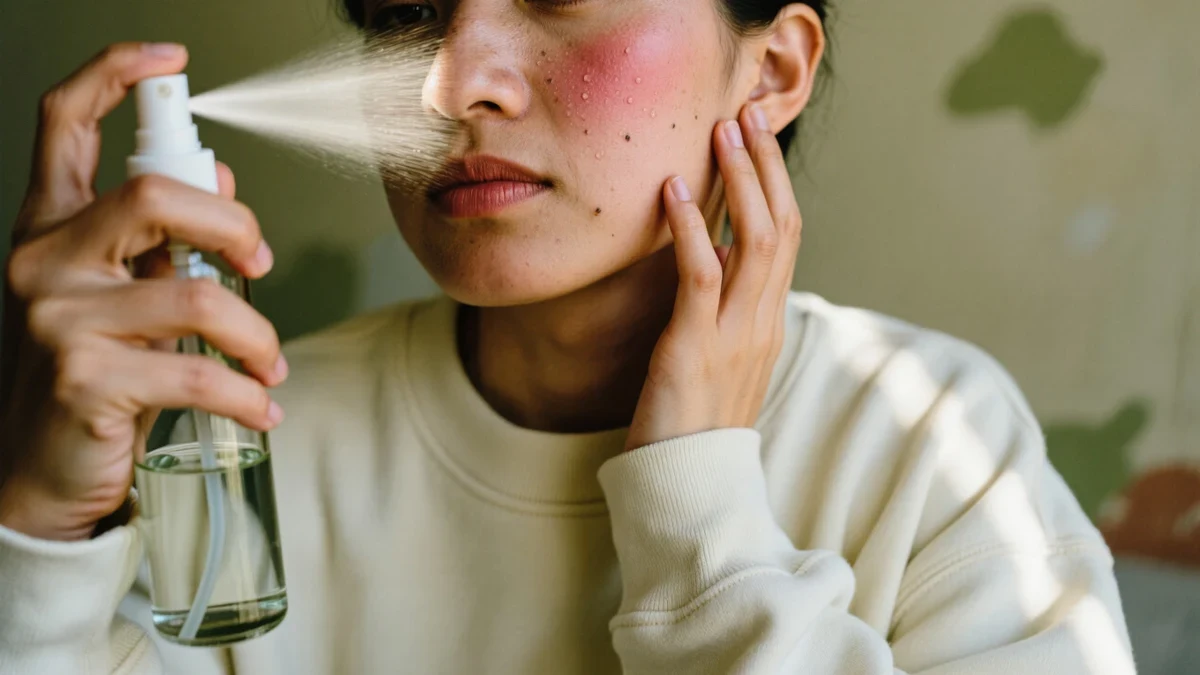
When the mist dries, its polymers and resins lock the underlying pigment layers against movement, which is why an even, ultra-fine spray matters: a coarse spray leaves uneven film thickness, and film thickness is what separates a set face from a patchy one. Saie describes its own spray as a non-aerosol, ultra-fine mist that disperses evenly and absorbs instantly, per the brand's listing. Wear-time claims such as the brand's 16 hours are the brand's own testing claims, not independent verification, and should be read that way.
Why are the newer formulas alcohol-free?
Older setting sprays used alcohol to flash off quickly, which set makeup fast but could leave dry or dehydrated-feeling skin, a trade-off readers with dry skin know well. Newer launches market alcohol-free versions, and Saie's CitySet is labeled alcohol- and scent-free, dermatologist tested, and non-comedogenic, per the brand's description. The word non-comedogenic is a marketing term without a standardized regulatory definition, so it reports the brand's labeling rather than a certification.
The brand's product page positions the formula for sensitive, blemish-prone, and dry skin, which again is the company's own claim. What the Journal of Cosmetic Science review does independently support is the category logic: film-forming systems are engineered for stability and even deposition, and hydration-oriented ingredients can be built into the same film. The review on PubMed covers how formulators balance these properties in color cosmetics generally.
What matters when choosing one?
Readers who dislike a tight, plasticky feel can look for formulas described as flexible-film or hydrating, mist from about 20 centimeters in an X and T pattern, and let it dry without fanning, since disturbing the film before it sets defeats its purpose. Nothing in a setting spray repairs skin, and no spray substitutes for sunscreen underneath. Anyone with reactive skin can patch-test along the jaw, because even alcohol-free polymer systems differ in their other ingredients. The evidence base for specific wear claims lives with each brand, so treat hour counts as company testing until an independent body says otherwise.
This article is for general information only and is not medical advice. For persistent skin, hair, or scalp concerns, consult a dermatologist or qualified healthcare professional.