Long-wear makeup stays put through film-forming polymers that dry into a flexible layer over pigment, waxes and emollients tuned for adhesion, and, in the newest mascaras, shape-memory polymers that set around a lash. A Skin Research and Technology study by Oriflame researchers used UV-fluorescence imaging to measure foundation wear beyond 24 hours; the method tracked trained graders almost perfectly.
What makes a foundation long-wearing?
A transfer-resistant film, plus pigments anchored inside it. A research team at Oriflame Research and Development in Bray, Ireland, led by C. Messaraa, developed a UV-fluorescence imaging method that quantifies how much foundation remains on skin as it is gradually removed, reporting a repeated-measures correlation of r = -0.86 against clinical grading and validating pass/fail thresholds "when assessing a foundation under real conditions for a duration over 24 hours," per the study in Skin Research and Technology. One detail deserves attention for deeper skin tones: the authors note the method "allows to assess their long wear properties, irrespective of basal skin tone or foundation shade," addressing a real historical gap in wear testing. Mechanistically, a long-wear foundation pairs its pigment with film-forming polymers that set into a thin, flexible coat, so the color sits in a matrix that resists transferring to masks, collars, and phone screens, while oils and waxes are kept low or emulsified so the film does not slide. The Oriflame team's thresholds were cross-validated on two subsets of a twenty-woman panel, and the paper's central contribution is methodological: a repeatable instrument read that brands can run consistently instead of relying solely on visual grading.
How do mascaras hold a curl all day?
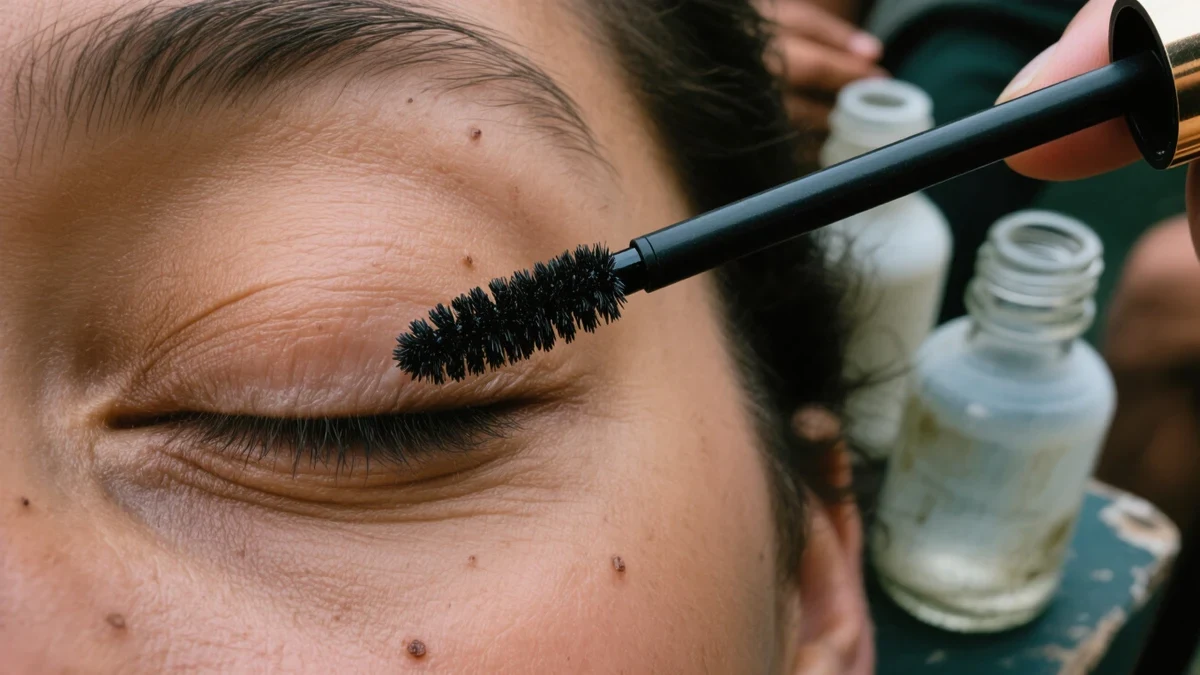
Increasingly, with polymers that respond to heat. Researchers Shiqian Chen and Syed Amin formulated an oil-in-water mascara with methoxy poly(ethylene glycol)-b-poly(D,L-lactide), or mPEG-PLA, a thermoresponsive shape-memory polymer. At 0.8% concentration the polymer raised emulsion viscosity from 0.20 to 1.00 Pa·s, and when applied with a heated applicator to false lashes, the polymer-containing formula "was found to produce a more pronounced and longer-lasting curl," per the study in the International Journal of Cosmetic Science. The authors frame it as a preliminary rheological study, so think of it as a proof of mechanism for heated-curl claims rather than a verdict on any specific tube. The rheology matters to shoppers in one concrete way: the polymer raised the formula's elasticity, and elasticity is what lets a coating bend with a lash through the day instead of flaking as the fiber moves, which is the failure mode curl-hold products are engineered against.
Does long-wear makeup interact with skincare actives?
Wear chemistry and treatment chemistry can coexist, per at least one controlled trial. A split-face study in the Journal of Clinical and Aesthetic Dermatology, authored by a team including Neal Bhatia and Leon Kircik, randomized 30 women to apply tretinoin 0.05% lotion to one side of the face before full-face foundation, and found "tretinoin 0.05% lotion did not interfere with facial makeup application or wearability and was well tolerated," per the published study. Participants even rated coverage and smoothness higher on the treated side. Disclosure: the study was funded by the lotion's manufacturer, so the compatibility finding is the company's own evidence, reported here as such.
What does the evidence not show?
No published method guarantees the claims language on a box, because wear claims are measured differently across brands and rarely with published thresholds. The UV-fluorescence work is an in-house industry lab's method, and the mascara polymer study ran on false lashes rather than people over a workday. The honest summary of the science: long-wear performance is real, measurable, and improving, driven by film-formers and now shape-memory polymers, but a 24-hour claim on a label reflects that brand's own test, not an independent standard. That gap between claim and verification is the reader's real leverage: asking what wear actually means for a specific product, whether the claim survived contact, rubbing, or a full day, and on which skin tones it was validated, turns a marketing line back into a formulation question. The 2021 foundation study is valuable precisely because it names its conditions, durations, thresholds, and panel, which is more operational detail than most packaging ever offers.
| Ingredient class | Role in long-wear formulas | Evidence anchor |
|---|---|---|
| Film-forming polymers | Flexible film that anchors pigment to skin | Foundation wear measured over 24 h (Skin Res Technol, 2021) |
| Thermoresponsive shape-memory polymers | Set and hold lash curl after heated application | mPEG-PLA mascara study (Int J Cosmet Sci, 2020) |
| Waxes and emollients | Adhesion, flexibility, resistance to creasing | Formulation composition in both studies |
| Pigments and powders | Optical coverage held within the film matrix | Both mascara and foundation formulations |
This article is for informational purposes only and does not constitute medical advice. Cosmetics are not treatments for medical conditions. For persistent skin, hair, or scalp concerns, consult a dermatologist or qualified healthcare professional.