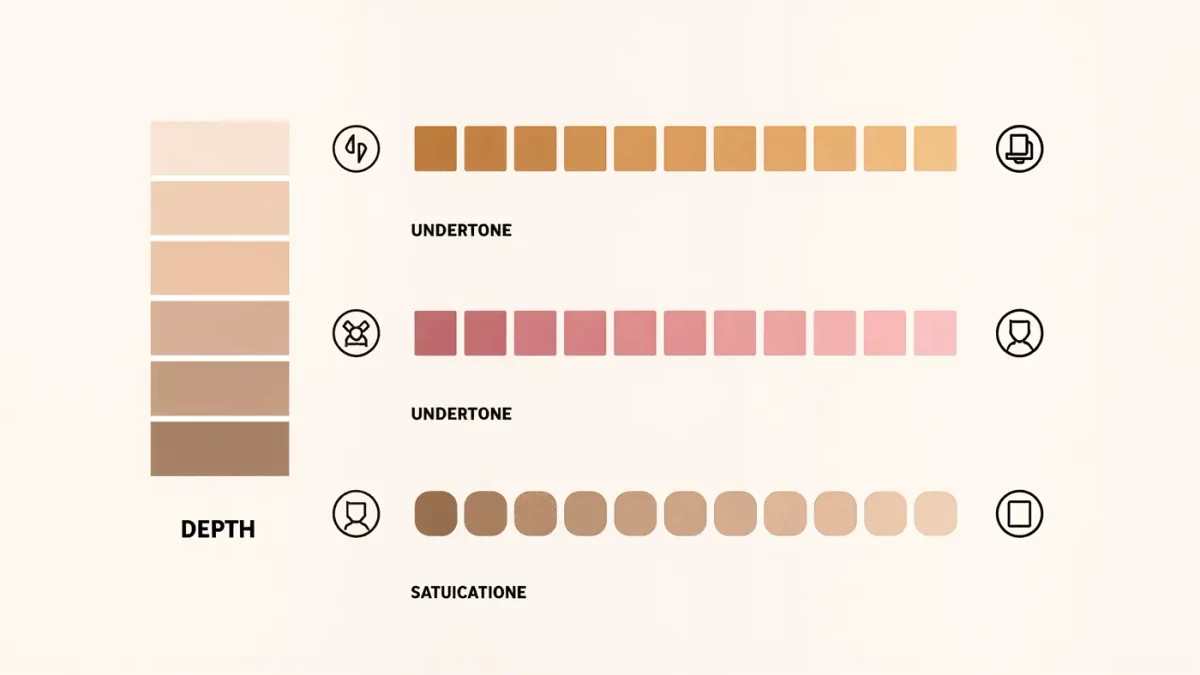
Foundation matches when two separate variables line up: depth, meaning how light or dark skin is, and undertone, the subtle red or yellow hue beneath it. A Dermatologic Surgery paper by dermatologists W. Coleman, Kavita Mariwalla, and Pearl Grimes proposed subdividing the most common skin-color categories into A and B subgroups because single labels hid too many distinct shades.
What is the difference between skin depth and undertone?
Depth is the axis most shade racks already encode: fair through deep. Undertone is the hue that remains as depth changes, conventionally described as cool, neutral, or warm, and in research terms as redness and yellowness. Coleman and colleagues, whose 2023 paper updated the Fitzpatrick classification into a Skin Color and Ethnicity (SCE) scale, concluded that Fitzpatrick types 4 and 5 "were the most confusing in that these included a broad range of skin types with different responses to solar radiation, lasers, surgery, and cosmetic products," per the study in Dermatologic Surgery. The practical takeaway for makeup wearers is that two people with identical depth can wear opposite undertones, which is why a shade that looks perfect on a friend can turn gray or orange on another face of the same depth. The SCE scale that emerged from Coleman and colleagues' work exists because clinicians kept hitting that wall: the authors' literature review of existing skin color scales, plus what they describe as "an extensive internet search... using makeup foundation ranges as a starting point for skin tone matching," showed that mid-depth categories lumped together skin that behaved differently in response to sun, lasers, and cosmetic products. Their fix, splitting types 4 and 5 into A and B subgroups, is a clinical reporting tool, but it formalizes what makeup wearers already sense: depth alone is not a shade.
How do researchers actually measure undertone?
With instruments, not vibes. A study published in Social Psychology Quarterly by sociologist Andrew Branigan and colleagues captured skin lightness-darkness and undertones using CIELAB colorimetry, the lab-standard color space also used in cosmetic efficacy testing, alongside a two-dimensional categorical scale. The researchers found that "respondents also perceived skin undertones consistently," meaning red and yellow undertones are real, measurable, and reliably seen by other people, not just a counter-side myth. That matters because foundation is calibrated against the same hue dimensions instruments measure: a shade that reads pink on a neutral face is usually a red-undertone shade sitting on yellow-undertone skin.
Why do so many people choose the wrong shade?
Preference drifts lighter, and the data shows it. In a study in the International Journal of Cosmetic Science, researchers at Beijing Technology and Business University assessed foundation preferences among women with sensitive skin across skin-tone types and found that "the results of the software evaluation showed that popular aesthetics preferred Type I and Type II to use No. 2, and Type III to use No. 2 and No. 3, as they resulted in a fairer complexion." The authors' conclusion is blunt about the mismatch: the findings "highlight the public's inclination towards lighter foundation shades, despite the common practice of selecting shades that harmonize with one's inherent skin tone." Lighting compounds the problem, since store lighting flattens both depth differences and undertone, and oxidization over a wear day shifts some formulas warmer or deeper than the swatch suggested. The study also documented measurable skin differences across its tone types, including higher transepidermal water loss and haemoglobin content in the sensitive group, a reminder that redness from irritation can masquerade as a cool undertone and nudge shade selection toward pink bases that no longer match once the irritation calms. Waiting until skin is in its normal, unprovoked state before shade-matching avoids that error.
How can readers test a shade before buying?
By separating the two variables, the way researchers do. The following sequence mirrors the logic of the shade-matching work described above: fix depth first, then adjust undertone.
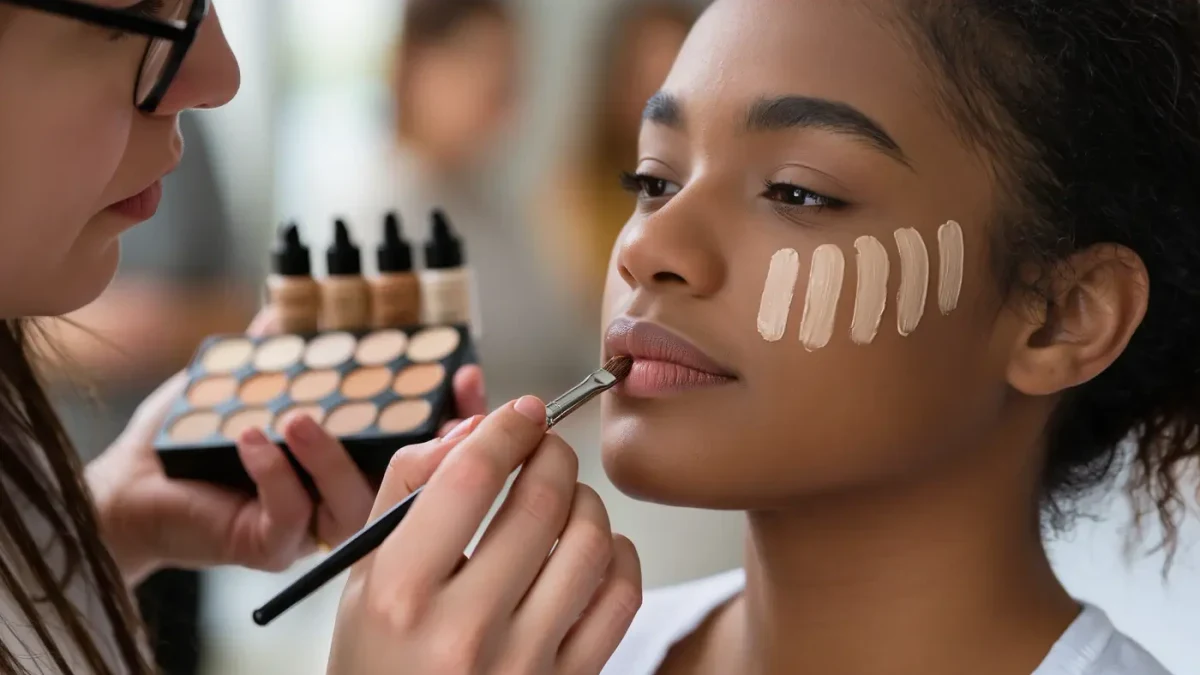
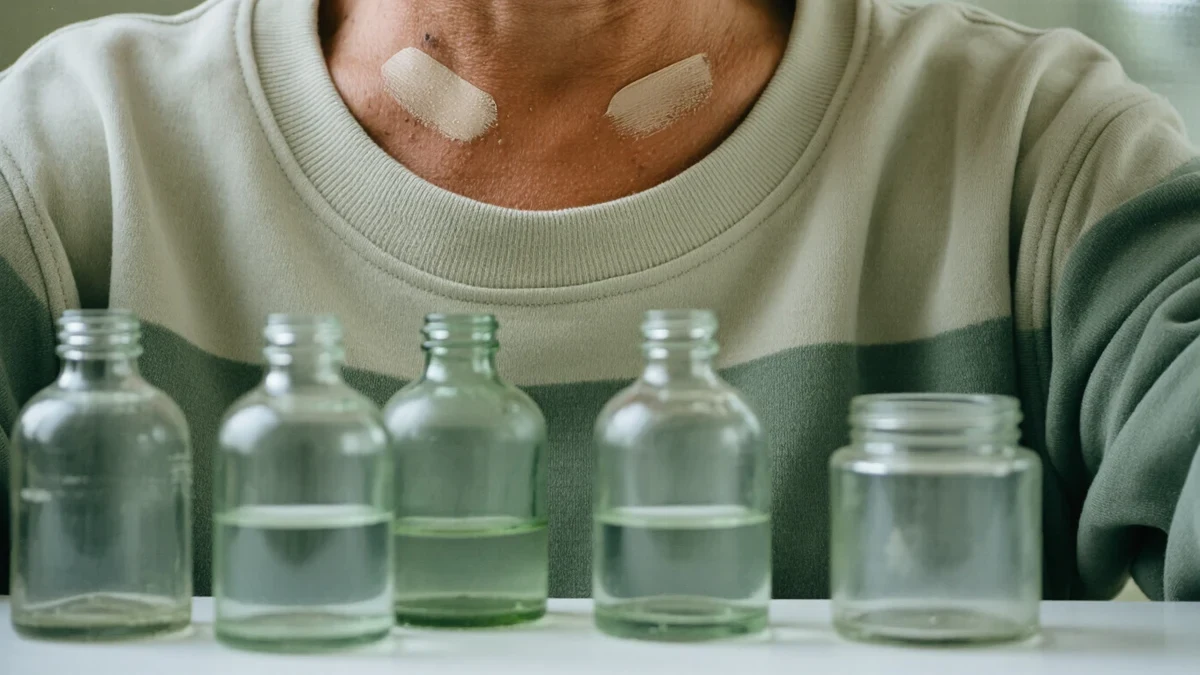
- Swatch three candidate shades in a vertical line along the jawline, not the hand or wrist, which rarely match facial depth and undertone.
- Check the swatches in daylight near a window; indoor lighting distorts both redness and yellowness.
- Pick the shade that disappears at the jaw boundary, which indicates matched depth.
- If every disappearing shade looks slightly gray or slightly orange, step one undertone level warmer or cooler respectively at the same depth, the same red-yellow adjustment CIELAB measurements track.
- Recheck after twenty minutes, since oxidation can shift shade on some formulas.
| Dimension | What it describes | How research measures it |
|---|---|---|
| Depth (lightness-darkness) | How light or deep the skin is | CIELAB L* values; shade-depth ordering |
| Red undertone | Cool pinkness beneath depth | CIELAB a* values; observer ratings |
| Yellow undertone | Warm goldenness beneath depth | CIELAB b* values; observer ratings |
What does the evidence not show?
No study guarantees a specific brand's numbering system, and shade names are marketing, not measurement. The SCE scale was developed for clinical reporting in skin of color research, not for retail racks, and the cosmetic-science study surveyed one population of Chinese women with sensitive skin, so its preference findings should not be generalized to everyone. What the evidence does support is method: match depth and undertone as separate decisions, verify in daylight, and treat any push toward a lighter shade as preference, per Branigan and colleagues' finding that undertone itself carries social meaning worth being deliberate about rather than defaulting on.
This article is for informational purposes only and does not constitute medical advice. Cosmetics are not treatments for medical conditions. For persistent skin, hair, or scalp concerns, consult a dermatologist or qualified healthcare professional.