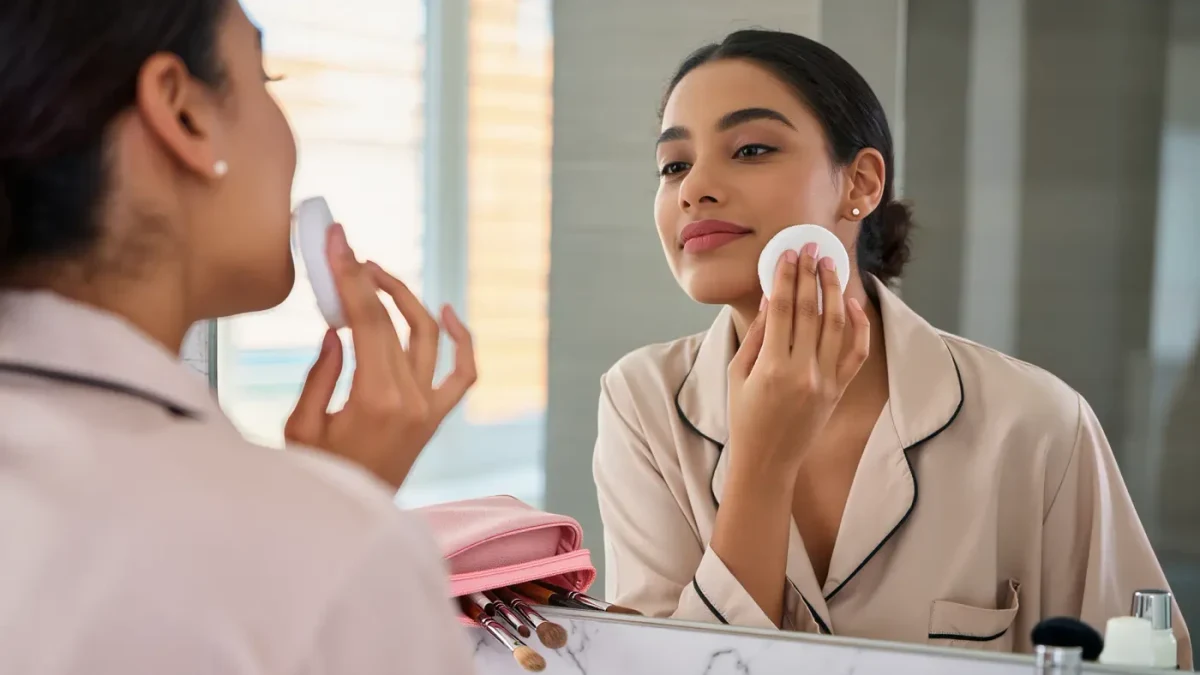
A minimal makeup look is built on prep and restraint, not on sheerer versions of a full routine. Makeup artist Alexx Mayo told Vogue that well-prepped skin gives you a beautiful, hydrated glow, which in return helps you use less product. The look lives or dies in the prep, not the makeup bag.
What is the minimal look, actually?
The current wave of minimalist makeup is a technique, not a single aesthetic. Vogue's 2026 guide to the trend, written with makeup artists including Ernesto Casillas and Allan Avendaño, describes building with lightweight layers, a lot like a watercolor painting, rather than masking and then carving features back in. The visual result reads as skin, freckles, texture, and tone present rather than erased, with definition concentrated in one or two places, usually brows and a flush of color on the cheeks.
Restraint is the distinguishing rule. Where a full-glam routine sets an even, uniform canvas and then adds dimension back, the minimal routine spots product only where the face wants it. The look also travels well across ages and skin tones precisely because it is subtractive: nothing in the method requires a particular undertone, and the trend coverage draws on artists working across the full range of complexions. What it does require is skin that is hydrated enough to be seen, which loops back to prep.
Why does prep do this much work?
Because sheer formulas are unforgiving surface reporters. A tinted moisturizer or skin tint evens tone by a few degrees, not dozens, so flaking, tightness, or an unbalanced barrier show through immediately. Mayo's framing to Vogue makes the economic case as well as the aesthetic one: if hydrated skin already reflects light evenly, the product needed on top shrinks. Dermatologists make the same point in barrier terms, intact skin holds water, sheds evenly, and reacts less, so the prep stage is skincare doing makeup's job.
Practically, prep in the artists' descriptions is unglamorous: cleanse, hydrate, and let each layer settle before the next. Vogue's guide has artists working in thin, buildable passes for the same reason, a watercolor layer that goes slightly wrong is corrected by the next layer, not removed and restarted. Readers with drier or more mature skin get the larger payoff here, since lightweight formulas sit best on a surface that is not competing with dryness.
How do artists build the base?
The signature move is pinpoint concealing. Covering the whole face is replaced by addressing only the spots that read as uneven. In Vogue's beauty coverage of Hailey Bieber's routine, foundation is often forgone in favor of pinpoint concealing, with concealer applied under the eyes, around the nose, and on the chin, a distribution any reader can mirror regardless of the products involved. A skin tint or tinted moisturizer, where used at all, comes after, in the thin layers Casillas describes.
The rest of the face follows the one-or-two-features principle. Avendaño's brow guidance in the Vogue guide is fill in your brows with a fine point brow pencil and draw hair-like strokes and then use a brow gel or pomade to groom them into place, which creates structure without a sculpted effect. Cream blush pressed high on the cheek adds the flush the look uses in place of contour, and mascara, often brown rather than black in minimalist palettes, finishes it. Gloss or balm replaces lip color saturation with condition.
What does a five-step version look like?
Assembled from the artists' own directions in Vogue's minimalist makeup guide, the routine runs:
- Prep with cleanser and moisturizer, letting hydration absorb fully before anything else, per Mayo's prep-first instruction.
- Conceal only where needed, under the eyes, around the nose, on the chin, the pinpoint distribution described in Vogue's coverage of streamlined routines.
- Add a skin tint or sheer base in thin layers if more evening is wanted, building like watercolor, per Casillas.
- Define brows with hair-like pencil strokes, then set with a clear gel or pomade, per Avendaño.
- Finish with cream blush on the apples and a swipe of balm or gloss, keeping saturation in one place.
Which formulas suit which skin?
Formula selection does the tonal work that coverage would otherwise do. For skin that shows texture or dryness, cream and liquid formats beat powders in the artists' layering logic, since a cream blush pressed into skin reads as flush while a powder sits on top of it. For skin that gets oily fast, the minimal version simply shrinks the cream footprint, a tint with a satin finish, concealer only where needed, and powder reserved for the T-zone rather than skipped everywhere else. Oily skin does not disqualify anyone from minimal makeup, it just changes which layers stay.
Mature skin gets the most from the method's subtractive logic. Because the technique never builds a uniform mask, there is no foundation line to settle into fine lines by afternoon, and the emphasis on hydration keeps lightweight formulas from accentuating dryness. The artists' watercolor instruction scales down as easily as it scales up, one thin pass of tint where two would read as coverage, which is why the same five steps work at twenty and at sixty. The variables are skin prep weight and where concealer lands, not the sequence itself.
What is this look not?
It is not a shortcut to perfect skin, and it is not a smaller quantity of a full-glam routine, it is a different sequence with different products. Readers should also read minimal beauty marketing with the usual skepticism: lightweight and skin-like are texture descriptions, not evidence of anything, and no tinted product replaces sun protection, which belongs in the prep stage of any version of this routine. Trend names cycle faster than techniques, and the label on this one will date before the method does.
What the artists' version offers is honest arithmetic: better prep plus fewer, lighter layers, which is why it photographs like skin instead of like coverage, and why it works on faces that never appear in the campaign imagery for the products it uses. The technique asks a reader to buy almost nothing new, only to redistribute effort toward the steps that used to be skipped. In a category engineered to sell the next product, a look built on restraint is the rare trend that costs less to do well, and the rare one a reader can test tomorrow morning with what is already on the shelf.
This article is for informational purposes only and does not constitute medical advice. Skincare and haircare needs vary by individual; consult a dermatologist or qualified healthcare professional before starting any new treatment, especially for persistent skin, scalp, or hair concerns.