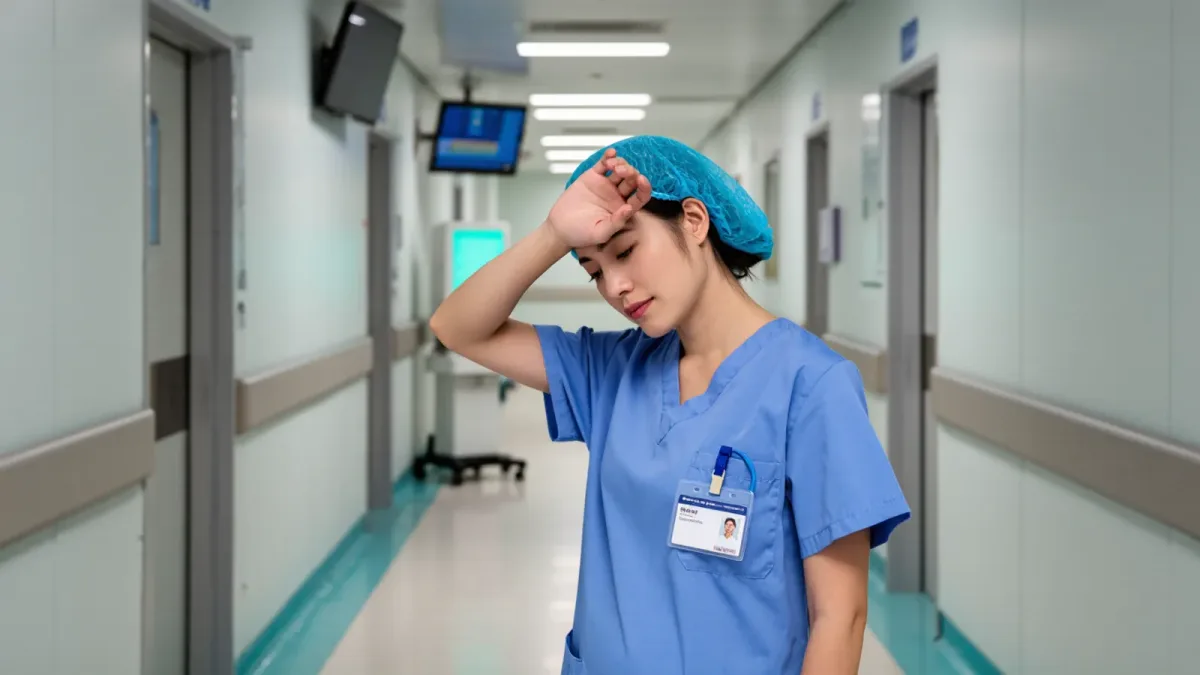
The World Health Organization defines burn-out as a syndrome "resulting from chronic workplace stress that has not been successfully managed." A review in Inflammation & Allergy Drug Targets links psychological stress to the onset or aggravation of multiple skin diseases. Burnout's visible symptoms are documented physiology, not vanity talking.
What Is Burnout, Strictly Speaking?
The WHO's definition, included in ICD-11, is deliberately narrow: burn-out "refers specifically to phenomena in the occupational context and should not be applied to describe experiences in other areas of life." Its three dimensions are feelings of energy depletion or exhaustion, increased mental distance from one's job or feelings of negativism or cynicism related to it, and reduced professional efficacy.
That precision matters for beauty coverage, because "burnout" has drifted into a marketing mood — burnout skincare, burnout recovery routines. Burnout is an occupational phenomenon in the WHO's classification, not a skin diagnosis. What the skin and hair literature actually studies is chronic psychological stress, of which workplace exhaustion is one common source.
The distinction protects readers from products that quietly borrow a clinical word. A cream marketed for "burnout skin" is making a stress-adjacent cosmetic claim at most; no cosmetic treats an occupational syndrome, and the evidence below is about stress physiology, not about any product fixing it.
What Does Chronic Stress Actually Do to Skin?
The mechanism story starts with cortisol and the stress-response system. The 2014 review "Brain-Skin Connection: Stress, Inflammation and Skin Aging" documents that the relationship between stress and skin conditions has been recorded since ancient times, and that recent clinical observations link psychological stress to the onset or aggravation of multiple skin diseases, with mechanisms only partially revealed in the past two decades across psychology, endocrinology, and skin immunology.
On the visible level, the review frames stress as a contributor to inflammatory skin conditions and accelerated skin aging — through neuroimmune and neuroendocrine pathways rather than a single overnight event. Translation for the mirror: stress-associated flare-ups of acne, eczema, and psoriasis are the best-evidenced skin effects, and they run through inflammation, not through one "stress toxin" a product could wash away.
For acne specifically, a published trial on psychodermatology in Dermatology Research and Practice states that stress "plays an important role in the causation and aggravation of psychodermatological conditions such as acne vulgaris." Notably, that same paper studied an ingestible ingredient — which is a reminder to read stress-and-skin product studies carefully: a single trial of a branded compound is early-stage evidence, not a category endorsement.
What Does the Evidence Say About Appearance Changes?
Readers usually ask about three things: dullness, breakouts, and hair shedding. The honest ranking is that flare-ups of existing inflammatory conditions carry the strongest evidence; hair shedding has a plausible mechanism via stress-driven shifts in the hair cycle, documented in the telogen effluvium literature; and "dull, tired" skin is a real-enough observation with the weakest evidentiary trail — affected by sleep, circulation, and barrier state, none of which any single cosmetic reverses.
| Claimed burnout effect | What research shows | Evidence strength |
|---|---|---|
| Acne flare-ups under stress | Stress implicated in causation and aggravation of acne vulgaris, per Dermatology Research and Practice | Clinical studies and reviews |
| Eczema and psoriasis flares | Psychological stress linked to onset or aggravation of multiple skin diseases, per the 2014 brain-skin review | Clinical observations and reviews |
| Stress-related hair shedding | Plausible via hair-cycle shifts; diagnosis requires a dermatologist | Mechanistic, condition-specific |
| "Burnout skin" fixed by a cream | No cosmetic treats an occupational phenomenon; WHO restricts burn-out to occupational context | Not supported |
What Actually Helps When Stress Shows Up on Skin?
The boring answer outranks the expensive one. Because the pathway is stress physiology, the interventions with the deepest support are stress-reducing and barrier-maintaining, not product-acquiring. Dermatological guidance for stressed skin is simply careful skin care — gentle cleansing, consistent moisturizing, and treating flares of diagnosed conditions with the help of a clinician.
- Treat flare-ups as a signal to simplify, not stack: a minimal routine of gentle cleanser, moisturizer, and sunscreen reduces variables on irritated skin.
- Protect sleep as a skin variable; the stress-sleep-skin overlap is where burnout and dermatology genuinely meet.
- Keep up prescriptions for diagnosed conditions — stress is an aggravator, and pausing treatment removes the control.
- View single-ingredient stress-skin trials as interesting, not conclusive; early-stage evidence deserves cautious wording.
- Bring persistent shedding or widespread flares to a dermatologist rather than self-diagnosing "burnout."
What the evidence does not show is any cosmetic that reverses chronic stress physiology, and marketing that implies otherwise is borrowing a WHO classification it has not earned. The kindest framing is also the truest: appearance changes under prolonged stress are common, documented, and manageable — with the stress itself, and with a dermatologist when the skin demands one.
What Should Readers Ignore in "Burnout Beauty" Marketing?
Once a clinical word becomes a mood, the claims drift quickly. Products labeled for "burnout skin" or "stress repair" are making cosmetic claims about appearance and feel — moisturizing, soothing, temporarily improving look — and none of them is evaluated against the WHO definition of anything. A reader can test any such claim with one question: which named study, in which journal, measured this outcome? If the answer is a brand's internal sensory panel, the claim is a texture preference, not a finding.
The same filter applies to "cortisol skincare." Cortisol's role in stress physiology is real and well documented in the brain-skin literature, but a cosmetic that claims to modulate cortisol in skin is making a drug-adjacent claim that would require exactly the kind of evidence no shelf tag carries. Regulators in the United States draw this line explicitly: cosmetics cleanse, beautify, and alter appearance; products that affect the structure or function of the body are drugs.
Wellness habits deserve the same honesty. Sleep, movement, and social recovery genuinely interact with stress physiology, and the WHO's framing of burn-out as an occupational phenomenon points toward workplace and workload solutions rather than purchases. A beauty publication can fairly say routine helps skin look better under stress; it cannot say a routine treats burnout, and neither can a bottle.
The useful takeaway is a calm one. Stress effects on skin and hair are common, studied, and manageable, the flare-prone conditions have real treatments, and the most evidence-backed "burnout beauty" routine is sleep, gentle care, sunscreen,
That framing also keeps the wellness lane honest. The WHO's occupational definition exists so that burnout is taken seriously as a workplace phenomenon with workload-level solutions; letting it become a skin type serves nobody but a product line. Skin under stress deserves care, and the worker under stress deserves more than a cream.
This article is for informational purposes only and is not medical advice. Cosmetics are not treatments for medical conditions. For persistent skin, hair, or scalp concerns, consult a dermatologist or qualified healthcare professional.