Iron deficiency can contribute to hair shedding, because hair follicles are among the first tissues the body shortchanges when iron runs low. According to Cleveland Clinic, when the body has to choose between sending limited oxygen to vital organs or to hair follicles, the organs win, and less blood and oxygen reaching the follicles can damage them and cause more shedding. The clearest marker of the body's iron stores is ferritin, a storage protein that a simple blood test can measure.
The connection has limits, though. Ferritin is the most efficient and cost-effective blood test for diagnosing iron deficiency, per the Office of Dietary Supplements at the National Institutes of Health, but it can be pushed up by inflammation, which can hide a real deficiency. That is why clinicians often pair ferritin with other measurements instead of treating one number as the whole answer.
What does iron actually do in the body?
Iron is a mineral the body needs to build hemoglobin, the protein in red blood cells that carries oxygen from the lungs to everything else. It also helps make myoglobin, which stores oxygen in muscle. Per Cleveland Clinic, registered dietitian Lisa Reitz explains that without enough iron, red blood cells cannot transport oxygen well, and people with iron deficiency develop smaller red blood cells because they carry less hemoglobin.
Most of the body's iron sits inside hemoglobin. The rest is stored as ferritin or hemosiderin in the liver, spleen and bone marrow, according to the Office of Dietary Supplements. A protein called transferrin moves iron through the blood, and a hormone called hepcidin regulates both how much iron the gut absorbs and where it gets distributed. Because the body loses only small amounts of iron in urine, sweat and shed skin, and loses more through menstruation, intake has to keep pace with those losses.
Why does low iron show up in hair?
Hair follicles are fast-growing tissue, and fast-growing tissue needs a steady oxygen supply. When iron stores drop, the body prioritizes oxygen delivery to essential organs, and follicles fall lower on the list. Cleveland Clinic describes the result directly: less blood and oxygen to the follicles can damage them and increase shedding. For some people, a change in hair is one of the first visible signs that iron is low.
What the retrieved evidence does not show is a precise ferritin number below which every person sheds hair. Hair shedding has many causes, including stress, thyroid changes and postpartum shifts, so low iron is one possibility to check rather than the default explanation. Readers weighing stress as a factor may find it useful to read how chronic stress shows up in skin and hair per a meta-analysis, since stress-related shedding follows a different timeline than deficiency-related shedding. Readers following this should also see How Chronic Stress Shows Up in Skin, per a Meta-Analysis.
What is ferritin, and why does the test matter?
Ferritin is the protein the body uses to stash iron for later. A serum ferritin test measures those stores, and it catches depletion earlier than most other tests. According to the Office of Dietary Supplements, serum ferritin falls during the first stage of iron depletion, so it can identify low iron status before iron-deficiency anemia develops. The same source states that a ferritin concentration below 30 micrograms per liter suggests iron deficiency, and a value below 10 micrograms per liter suggests iron-deficiency anemia.
One big caveat sits in that same fact sheet: inflammation, including during infections, can elevate ferritin, so a normal-looking number does not always rule out deficiency. Hemoglobin and hematocrit are the most commonly used screening measures, but they are neither sensitive nor specific on their own. This is why providers often order several measurements together. Anyone reading results alone at home should know that interpretation depends on the full picture, which is what a clinician is for.
Who is most at risk of iron deficiency?
The risk is uneven, and it maps onto blood loss and increased demand. The World Health Organization considers iron deficiency anemia the most common nutritional deficiency in the world, and Cleveland Clinic reports the organization's estimate that it affects about 30% of people globally. Groups at higher risk include people who are pregnant, people with heavy menstrual periods, frequent blood donors, and people whose medications interfere with iron absorption, such as proton pump inhibitors used for acid reflux.
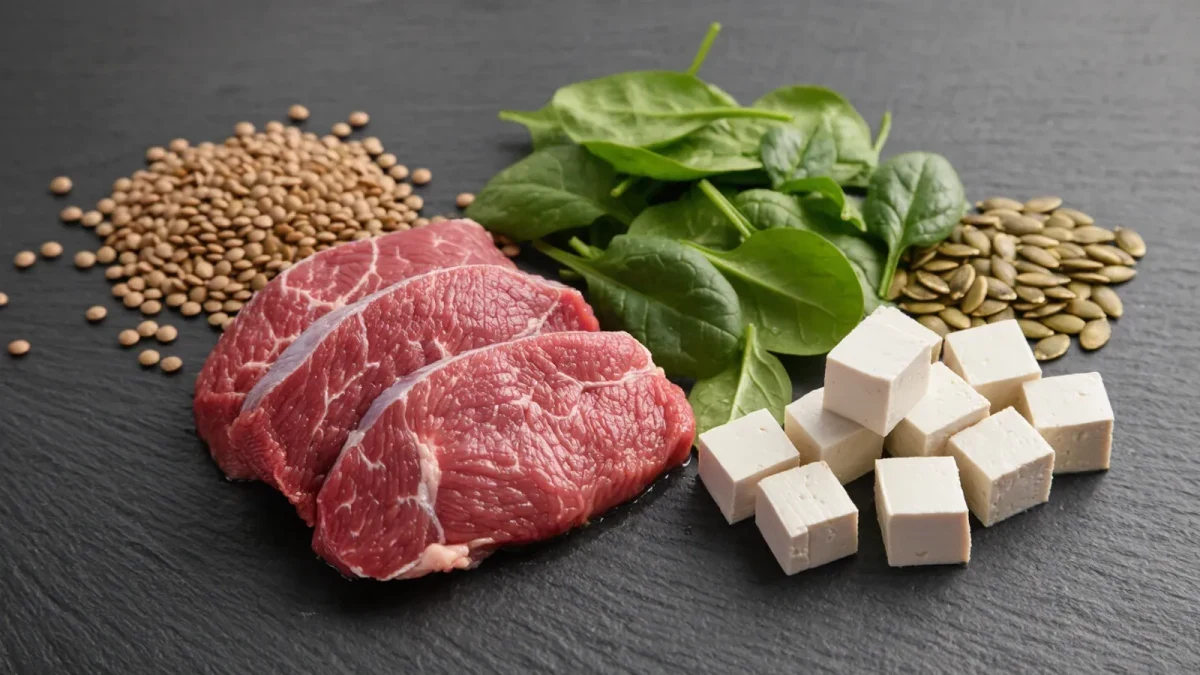
Diet plays a role too. Iron comes in two forms: heme iron from meat, seafood and poultry, which the body absorbs well, and non-heme iron from plants and fortified foods, which it absorbs less efficiently. Per the Office of Dietary Supplements, people following vegetarian diets need more iron because non-heme iron has lower bioavailability. Harvard's Nutrition Source adds that vitamin C eaten at the same meal improves non-heme absorption, while bran fiber, large calcium doses and plant compounds like phytates and tannins inhibit it. For more on how food choices reach the scalp, see what the evidence really says about diet, hair, and skin.
How much iron do people actually need?
Recommended amounts vary by age, sex and life stage. Harvard's Nutrition Source lists the Recommended Dietary Allowance for adults 19 to 50 as 8 milligrams daily for men, 18 milligrams for women, 27 milligrams during pregnancy and 9 milligrams during lactation. The higher figures for women reflect menstrual blood loss, and the pregnancy figure reflects the extra blood circulation a growing fetus requires. After menopause, the recommendation drops to 8 milligrams, though Harvard notes women should keep following the younger-women figure until menopause is confirmed.
There is also a ceiling. The Tolerable Upper Intake Level is 45 milligrams daily for everyone aged 14 and up, per Harvard's Nutrition Source, because too much iron carries its own risks. That matters for the supplement aisle, where products vary widely and labels can confuse.
What should readers know before supplementing?
Supplement labels list two numbers, and mixing them up is common. Harvard's Nutrition Source explains that the larger number on a label is the chemical compound, such as 325 milligrams of ferrous sulfate, while the smaller number is the elemental iron the body can actually absorb, such as 65 milligrams. Elemental iron is the number that matters. Different forms, including ferrous gluconate and slow-release versions, differ in cost, absorption and gastrointestinal side effects like constipation and nausea.
The practical sequence, per the retrieved sources, runs testing first and supplementation second. Ferritin testing establishes whether a deficiency exists at all, and a clinician can specify both the elemental and compound amounts if a supplement is warranted. High-dose over-the-counter products, some containing 65 milligrams or more of elemental iron, exist for people with diagnosed anemia or high risk, not as a general hair routine. Readers tempted by a general hair vitamin may want to compare that approach with how biotin supplements stack up against the evidence. And if shedding continues despite normal labs, a dermatology visit can sort through the other causes, which is a different appointment than a nutrition one.
What this means for your hair routine
The evidence supports a narrow but real claim: iron deficiency can drive hair shedding, ferritin testing can detect low stores early, and correcting a documented deficiency is the fix, not guessing. It does not support taking iron "for hair" without a test, because excess iron is not harmless and shedding has other causes. The strongest move is a blood test, a food-first approach within recommended limits, and patience, because follicles respond slowly once the underlying issue is addressed. Readers mapping the bigger picture of scalp care can browse the site's haircare coverage alongside its wellness section.