Permanent hair dye chemically restructures the hair fiber, and a 2024 study published in Heliyon quantified the cost: even a single dyeing session inflicted noticeable harm, while damage escalated significantly after three or more consecutive treatments. Using atomic force microscopy and tensile testing, the researchers tracked progressive changes to the cuticle surface through ten rounds of dyeing.
What does dye actually do inside the hair?
Permanent color works by lifting the cuticle, bleaching the hair's natural melanin with hydrogen peroxide, and depositing synthetic dye molecules inside the cortex. That three-step chemistry is why permanence and damage arrive together: the same process that removes natural pigment also alters the fiber's proteins. Grey and coarser hair types respond differently to the same protocol, which is one more reason strand tests before full application are standard practice.
The Heliyon study, by researchers at Kyung Hee University and Cosmax R&D, put numbers on it. Chemical dyes affected the hair fibers' morphology, physical structure and protein composition; nanoscale damage to the cuticle surface intensified proportionally with each additional dyeing session, while mechanical properties and protein composition changed non-linearly.
For planning purposes, the non-linear part matters most. The jump from one dye session to three produced the clearest escalation in damage per the authors' data — a case for stretching the time between color services rather than counting total sessions alone. The study covered hair from donors across the Heliyon repeated-dyeing protocol, and its progressive design is what makes the dose-response visible at all.
How is color-treated hair regulated and sold?
Most permanent, semi-permanent and temporary dyes belong to a category the FDA calls coal-tar hair dyes — a name that survives from the industry's early days, though most modern dyes are petroleum-derived synthetics. Per the FDA's consumer page on hair dyes, these products are exempt from the pre-market color-additive approval that governs most cosmetics, and the agency's ability to act against them is limited by law.
That regulatory structure places responsibility on labeling and directions; the FDA advises consumers to follow label directions and understand the risks, including allergic reactions. The practical implication for readers: a patch test before each use is a label instruction, not an optional extra.
Salon and at-home formulas sit inside the same regulatory category, so the choice between them is a matter of application skill and peroxide strength, not different oversight. Where a professional earns their fee is in controlling those variables — and in keeping lift within the range the fiber data says is survivable.
Timing discipline belongs in that same bucket. Leaving dye on longer than the label directs does not buy depth so much as extra exposure — and the Heliyon protocol shows what accumulated exposure does to cuticle nanostructure, session after session. Labels, in this category, are the closest thing to a dosing instruction cosmetics offer. Treating them that way is the cheapest protection a color client can buy.
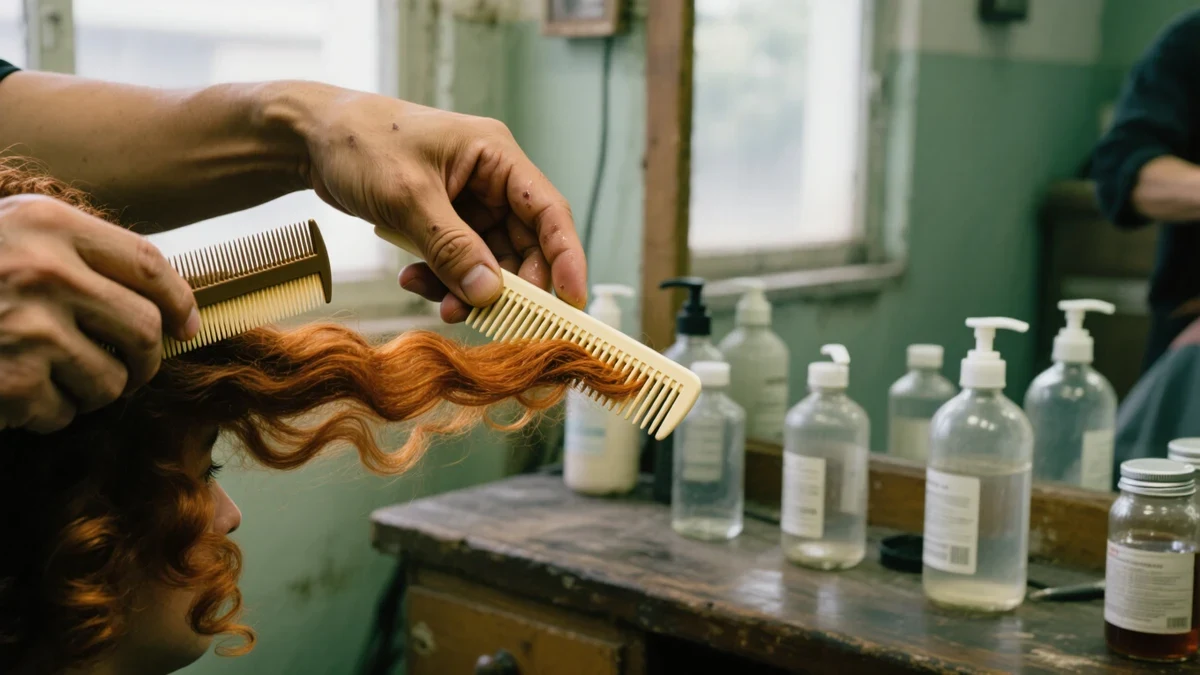
Between services, wet hair is the high-risk state. Fiber swelling stresses an already-processed cuticle, so the moments around washing — combing, towel-drying, heat — are when treated hair snaps. Handling hair gently while damp, and detangling from the ends upward, costs nothing and protects the exact region the roughness data identifies as most fragile.
Color-safe shampoos, for their part, are best judged as formulation choices rather than as a certified category. Lower-surfactant systems, cooler water and fewer washes all reduce the swelling-and-friction cycle the fiber studies describe; whether a bottle says "color safe" matters less than what its ingredient list and instructions actually do.
What helps treated fibers hold up?
The published evidence favors managing roughness and breakage points over repairing dye chemistry. A study in the International Journal of Trichology by Marico R&D researchers found that hair tips showed roughly 100% more surface irregularity than roots, and that hair breaks where the fiber's diameter is most irregular — the weakest-link pattern, with a correlation of R2 = 0.86.
The same study found that twenty cycles of coconut oil application reduced surface roughness by about 30%, while the shampoos and conditioners tested did not lead to much change on that specific metric, per the International Journal of Trichology findings. That is one company's research on its own category, reported as such — but it aligns with the trichological principle that pre-wash oiling can reduce water uptake and, with it, swelling stress on already-processed fibers.
Conditioners still matter for what they measurably do: reducing friction and snagging during brushing, which is when fragile ends most often snap. The roughness metric and the breakage data together suggest combining both approaches — slip at the mid-lengths and ends, oil before the wash on the most processed inches.
| Dye type | Chemistry | Documented fiber impact |
|---|---|---|
| Permanent | Peroxide lift plus synthetic dye deposition | Protein and cuticle damage from a single session; escalates over three-plus sessions (Heliyon) |
| Semi-permanent | Deposition without full lift | Fades over washes; gentler damage curve per category chemistry |
| Temporary | Surface coating pigments | Shampoos out; minimal structural change |
What does a color-care routine look like in order?
Assembled from the dyeing study's damage findings, the FDA's labeling guidance and the trichology data on fiber roughness, a color-treated routine sequences like this.
- Space color services as far apart as your regrowth tolerance allows; damage compounds per session, per the Heliyon data.
- Stay close to your natural depth when dyeing — greater peroxide volume for bigger lifts means more fiber damage.
- Reduce washing frequency and use cooler water to limit cuticle swelling on processed hair.
- Target the oldest, most irregular inches — ends — with conditioning and, per the Marico research, consider pre-wash oiling.
- Trim mechanically damaged ends on a schedule; the weakest-link research shows breaks cluster where diameter is most irregular.
- Handle wet hair gently: swell-stressed cuticles are most vulnerable exactly when damp.
What the evidence does not show
No published study demonstrates that any cosmetic product reverses oxidative dye damage; claims of "repair" refer to improving feel, alignment or roughness metrics, not restoring original protein structure. Bond-building marketing sits in the same evidentiary gap this file cannot close — an honest label says it improves manageability, not that it rebuilds hair.
The honest frame is damage management — fewer, farther-apart chemical sessions plus mechanical kindness — and that frame is what the fiber data actually supports. Readers who want the longest color life for the least chemistry can also consider glosses and demi-permanent refreshes between full services, categories designed to deposit with minimal lift.
This article is for informational purposes only and does not constitute medical advice. For scalp reactions, hair loss or persistent breakage, consult a dermatologist or qualified healthcare professional.