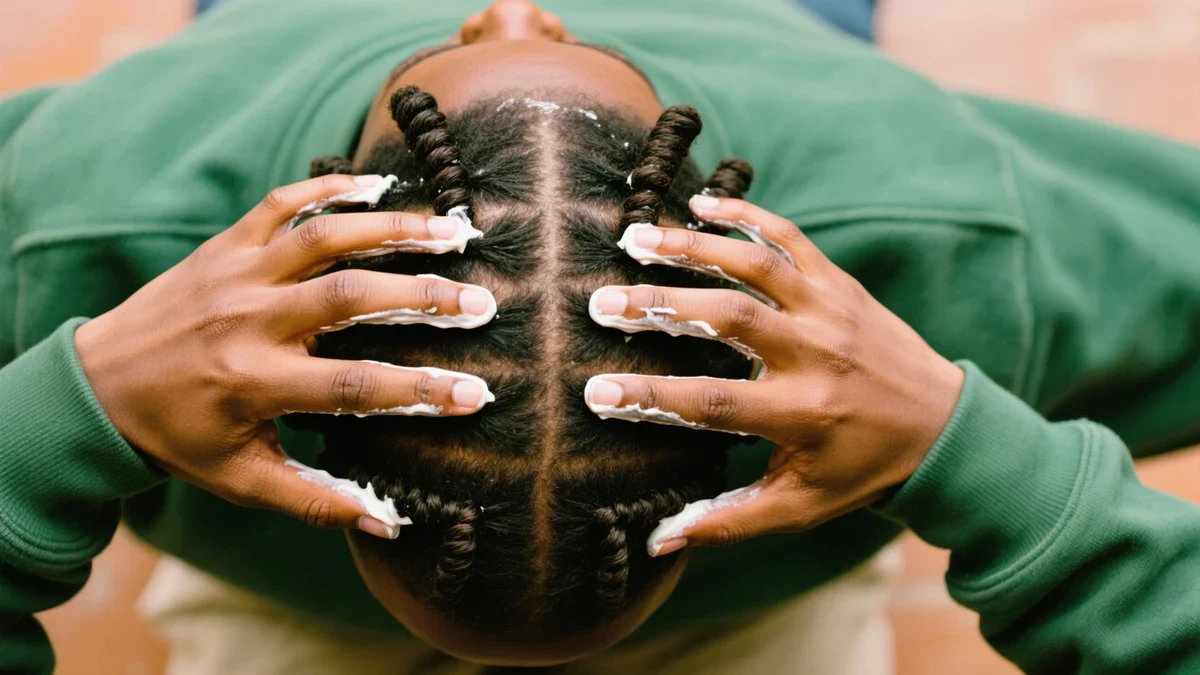
Textured hair breaks for measurable, mechanical reasons: a study in the International Journal of Cosmetic Science found cuticle damage from 480 combing strokes exceeded that from frequent braiding, and a February 2026 review in the International Journal of Women's Dermatology synthesized the same evidence for dermatologists.
What makes textured hair structurally different?
The 2026 review, published in the International Journal of Women's Dermatology, opens from the premise that Afro-textured hair has unique structural and biochemical properties that influence hair behavior and clinical outcomes. It defines Afro-textured hair as a spectrum of fibers consistent with established characteristics of African hair, irrespective of georacial origin, and organizes the literature into six domains, including biochemical structure and behavior and hair products and styling practices.
The fiber mechanics behind breakage were mapped by a study in the British Journal of Dermatology. Working with hair from an African-American volunteer, researchers applied controlled mechanical stress and imaged the fiber, proposing a breakage sequence of cuticle sliding, failure of the cuticle-cortex interface, and the nucleation and growth of cracks at the cuticle-cortex junction. That geometry explains why repeated bending, twisting and tension concentrate damage at points along a curved strand, and it frames the finding from a multiethnic L'Oreal Institute study cited in the same paper that 96 percent of African-American respondents reported breakage.
How much does grooming itself damage the fiber?
More than most routines assume. The Johannesburg study in the International Journal of Cosmetic Science compared 15 frequent braiders, women who braided more than 8 times per year, with 15 occasional braiders. All measurements showed a relationship between fiber damage and braiding frequency: frequent braiders had thinner hair, more cuticle damage under electron microscopy, significantly weaker fibers in tensile testing, and higher traction alopecia severity scores.
The combing arm of the same study found a linear trend between surface damage and the number of combing strokes, with 480 strokes producing cuticle damage more severe than frequent braiding. The practical translation is not to stop styling; it is that cumulative mechanical repetition, stroke by stroke, braid by braid, is the measurable driver of damage, and reducing repetition reduces the measured outcome.
What does low-manipulation styling actually mean?
It means minimizing repeated mechanical events along the strand. Building on the three studies above, a technique guide for coily and curly textures looks like this:
- Detangle in sections with the fingers or a wide-tooth tool, since every additional stroke adds to the linear damage relationship documented in the combing study.
- Work with saturated, conditioned hair where possible; the fiber-mechanism study shows cracks propagate under dry repeated flexion and torsion.
- Space out braiding and extension installs; frequent braiding was associated with weaker fibers and higher traction scores in the Johannesburg cohort.
- Keep braid and ponytail tension low at the hairline, where traction alopecia scoring concentrates.
- Favor styles that hold for days over daily restyling, converting many small mechanical events into few.
What does the review say about products?
On the product side, the six-domain review folds hair products and styling practices into one domain rather than ranking ingredients, and its practical recommendations center clinician education: classification and terminology, diagnostic approaches, and cultural humility in the exam room. That is a meaningful signal for readers navigating shelf claims, because the review's emphasis falls on matching care to the fiber's documented behavior rather than on any named active.
Where ingredients do enter the textured-hair conversation, the evidence base is thin and mostly mechanical: emollients and film-formers that reduce friction during grooming act on the same damage pathway the combing study measured. Claims that a product rebuilds fiber or reverses traction changes do not have support in any of these three papers.
| Grooming practice | Measured effect | Study |
|---|---|---|
| 480 combing strokes | Cuticle damage more severe than frequent braiding | Int J Cosmet Sci, 2021 |
| Braiding more than 8 times per year | Thinner fibers, more cuticle damage, weaker tensile strength, higher traction scores | Int J Cosmet Sci, 2021 |
| Repeated elongation, torsion, flexion | Crack growth at the cuticle-cortex junction | Br J Dermatol, 2015 |
Where does the evidence still fall short?
The 2026 review is candid about limits: as a narrative review it lacks a systematic search strategy and formal quality appraisal and is subject to selection bias, and the field's terminology itself is still being standardized. What the evidence does not show is any single product category regenerating fiber structure or reversing traction loss; the documented levers are mechanical, on the styling side, and clinical, on the treatment side. Scalp pain, shedding patches or widening part lines are medical signs, and the review's whole purpose is equipping dermatologists to treat textured-hair patients well, so those symptoms belong in a dermatology chair, not in a product aisle.
This article is for informational purposes only and is not medical or trichological advice. For scalp pain, hair loss or persistent breakage, consult a dermatologist or qualified healthcare professional.