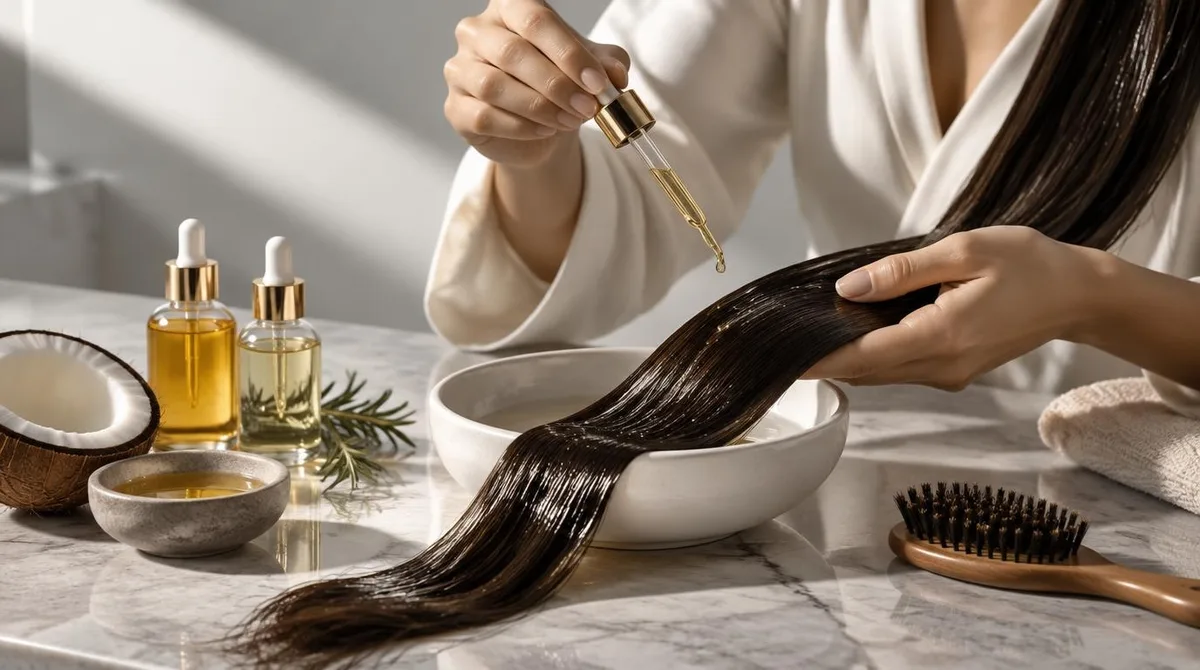
Hair oiling is the practice of applying plant oils to hair, either before shampooing or after it. What the oil does depends on its chemistry: some oils penetrate the hair fiber, while others mostly coat the outside of it. That single distinction decides whether an oil helps protect the fiber during washing or just adds surface shine.
Coconut oil is the clearest example of a penetrating oil in common use. Argan oil sits closer to the coating end of the spectrum, which is why it reads as a finisher rather than a treatment. Rosemary oil is a different case entirely: the popular claims are about the scalp and hair growth, and the evidence for those claims is thinner than social media suggests.
To see why any of this matters, it helps to know what a hair fiber actually is. According to Wikipedia's anatomy reference on hair, the visible hair shaft is a dead, protein-rich filament made mostly of alpha-keratin, built in layers: an overlapping cuticle on the outside, a strong keratin-packed cortex inside, and sometimes a central medulla. Because the shaft is dead tissue, an oil cannot repair it. It can only coat it, fill gaps, or reduce how much water and damage get in.
What does hair oiling actually do to the fiber?
It does two possible things, and the oil's molecule size decides which. Small, straight-chain fatty acids such as lauric acid can slip between the cuticle scales and into the cortex. Larger, bulkier molecules stay on the surface, where they smooth the cuticle and cut down friction between strands.
Both actions have value, but they are different values. A penetrating oil reduces how much water the fiber absorbs and swells, which matters because repeated swelling and drying is one way fibers fatigue over time. A coating oil reduces tangles and adds slip, which matters because combing forces are a daily source of cuticle wear.
What an oil cannot do is rebuild anything. The same anatomy reference is explicit that the hair shaft shows no biochemical activity; it is considered dead tissue. Any product language implying repair of the living hair should be read as marketing, not fiber science. For a closer look at how fibers actually change over time, see how repeated coloring changes hair fibers, according to research.
Penetration or coating: which oils do which?
The usual dividing line is the dominant fatty acid in the oil. Oils rich in lauric acid, a short straight-chain fatty acid, are the ones associated with penetration into the cortex. Oils rich in oleic or linoleic acids with bulkier structures, and oils high in long-chain waxes and esters, tend to stay on the surface.
| Oil | Main behavior on the fiber | Best read as |
|---|---|---|
| Coconut | Penetrating; lauric acid is small and straight enough to enter the cortex | A pre-wash protective treatment |
| Argan | Mostly coating; larger unsaturated molecules sit on the surface | A finisher for shine and slip |
| Rosemary | A fragrant essential oil, almost always diluted in a carrier; the carrier does the fiber work | A scalp-directed product, not a fiber treatment |
The coconut-versus-argan split also explains a common disappointment. Readers who apply argan oil hoping it will condition the inside of the fiber often find it mainly adds shine. That is the oil doing exactly what its chemistry allows, nothing more.
Which oil suits your porosity?
Porosity describes how easily the fiber takes in and loses water, and it changes the answer. High-porosity hair, often the result of coloring, heat damage, or naturally open cuticles, loses moisture fast and benefits from both penetration and a sealing layer on top. Low-porosity hair resists absorbing anything, so heavy oils can simply sit there and feel greasy.
For high-porosity fibers, a penetrating pre-wash oil followed by a light coating oil on damp hair covers both needs. For low-porosity fibers, thin applications of a lighter oil on warm, damp hair are usually more comfortable than thick layers. The full definitions and tests are covered in what hair porosity actually means for your routine, per research. This connects to our earlier piece, What Hair Porosity Actually Means for Your Routine, per Research.
Texture matters too. Coily and tightly curled fibers have more points where cuticles lift and strands rub, so coating oils that reduce friction earn their place in those routines. The technique side is covered in how to care for textured hair, according to dermatological research.
Pre-wash or post-wash: does timing matter?
Yes, and the reason is water. A pre-wash oiling coats the fiber before shampooing, when the oil can act as a buffer while the hair is wet and at its most vulnerable. A post-wash oiling works on damp or dry hair, where its main jobs are sealing in moisture and reducing combing friction.
A practical order looks like this:
- Apply the penetrating oil to dry hair before washing, working from mid-lengths to ends.
- Leave it in long enough to do its work; the fiber is dead tissue, so there is no waiting for a biological reaction, only for absorption.
- Shampoo as usual, focusing the lather at the scalp.
- On damp hair, apply a small amount of a coating oil to seal and add slip before detangling.
One caution applies to everyone: more oil is not more protection. Thick layers are harder to shampoo out fully, and residue on the scalp can weigh hair down or feel irritating. The scalp-care basics behind that point are covered in scalp care explained: what dermatologists recommend for healthy hair.
What do the rosemary oil claims actually show?
Rosemary oil is an essential oil, not a fatty carrier oil. It does not penetrate or coat the fiber in any meaningful way; whatever reaches the scalp is the point of the product. The popular claim is that rosemary oil supports hair growth, comparable to established treatments.
Here the honest answer is narrower than the hype. Small studies on rosemary oil and hair growth exist and are widely cited, but this piece's retrieved evidence base does not include any rosemary trial, so no specific result, comparison, or effect size can be stated here as fact. What can be said with confidence is what the anatomy shows: hair grows from living follicles beneath the skin, and an oil applied to dead shafts above the skin has no demonstrated route to change that biology.
Readers weighing growth claims should apply the same standard to any botanical: check whether a named, peer-reviewed trial backs the specific claim, and whether the comparison group was meaningful. The broader evaluation framework is laid out in what the evidence really shows for hair growth ingredients and claims. Also note that essential oils must be diluted in a carrier before touching skin; undiluted use is a known irritation risk. Readers following this should also see What the Evidence Really Shows for Hair Growth Ingredients and Claims.
What this means for your shelf
The evidence supports a modest, specific use for hair oiling. Coconut oil earns its place as a pre-wash treatment for fibers that take a beating, especially high-porosity, colored, or textured hair. Argan oil earns its place as a finisher for shine and slip. Rosemary oil is a scalp product whose growth claims rest on evidence this piece cannot verify, so treat it as an unproven extra rather than a treatment.
None of these oils repairs damage. Where fibers are genuinely weakened, the ingredient class designed for that job is different, as covered in what bond-building hair treatments actually do, according to studies. And where the goal is simply clean, well-conditioned hair, the workhorses are already in the shower: how shampoo surfactants cleanse hair, according to cosmetic science, and what hair conditioner ingredients actually do, according to trichology research, explain those in detail.